Musakhan
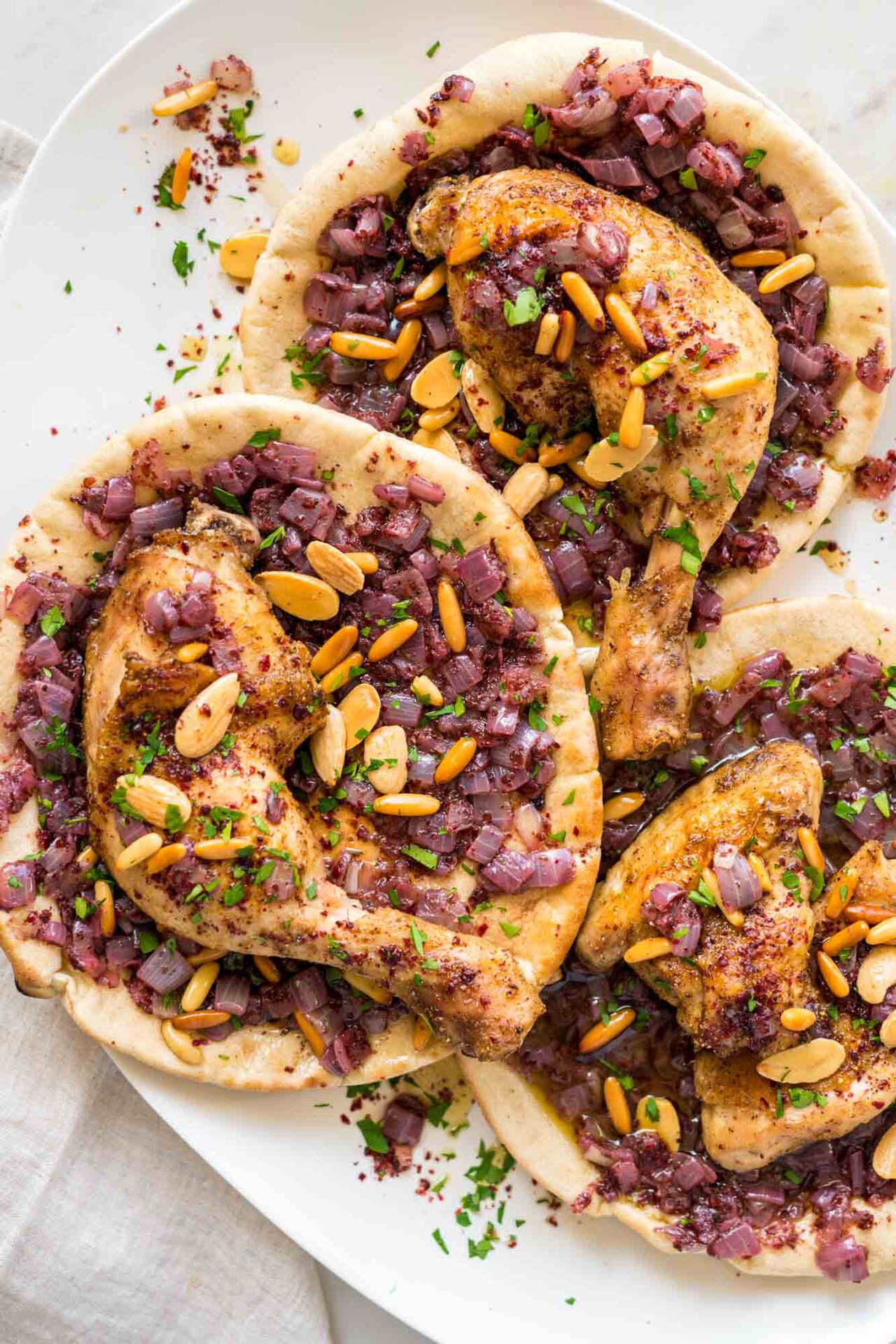
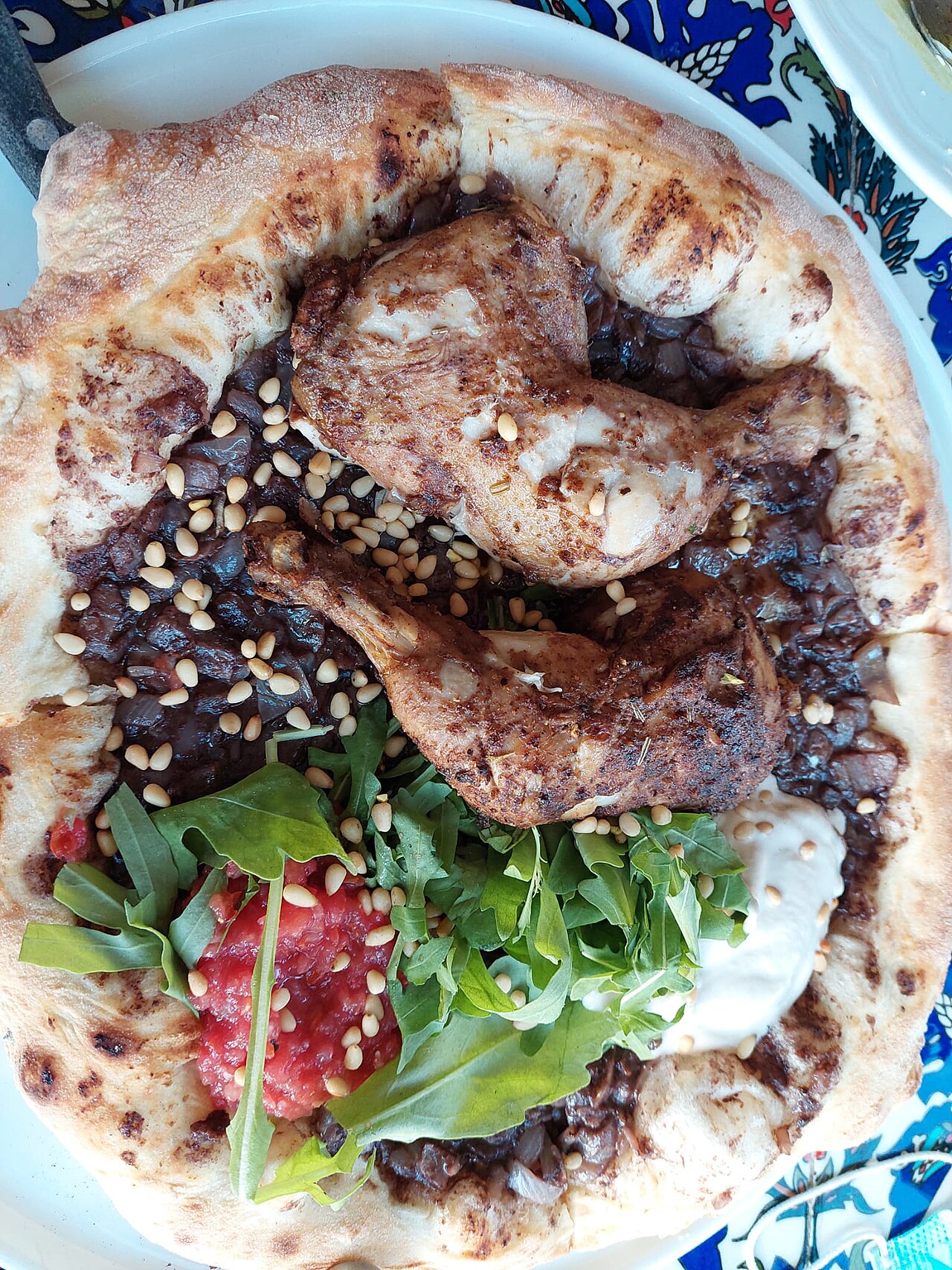
Palestinian roasted chicken dish with sumac and taboon bread.

Freedom's Falcon · CC BY-SA 4.0
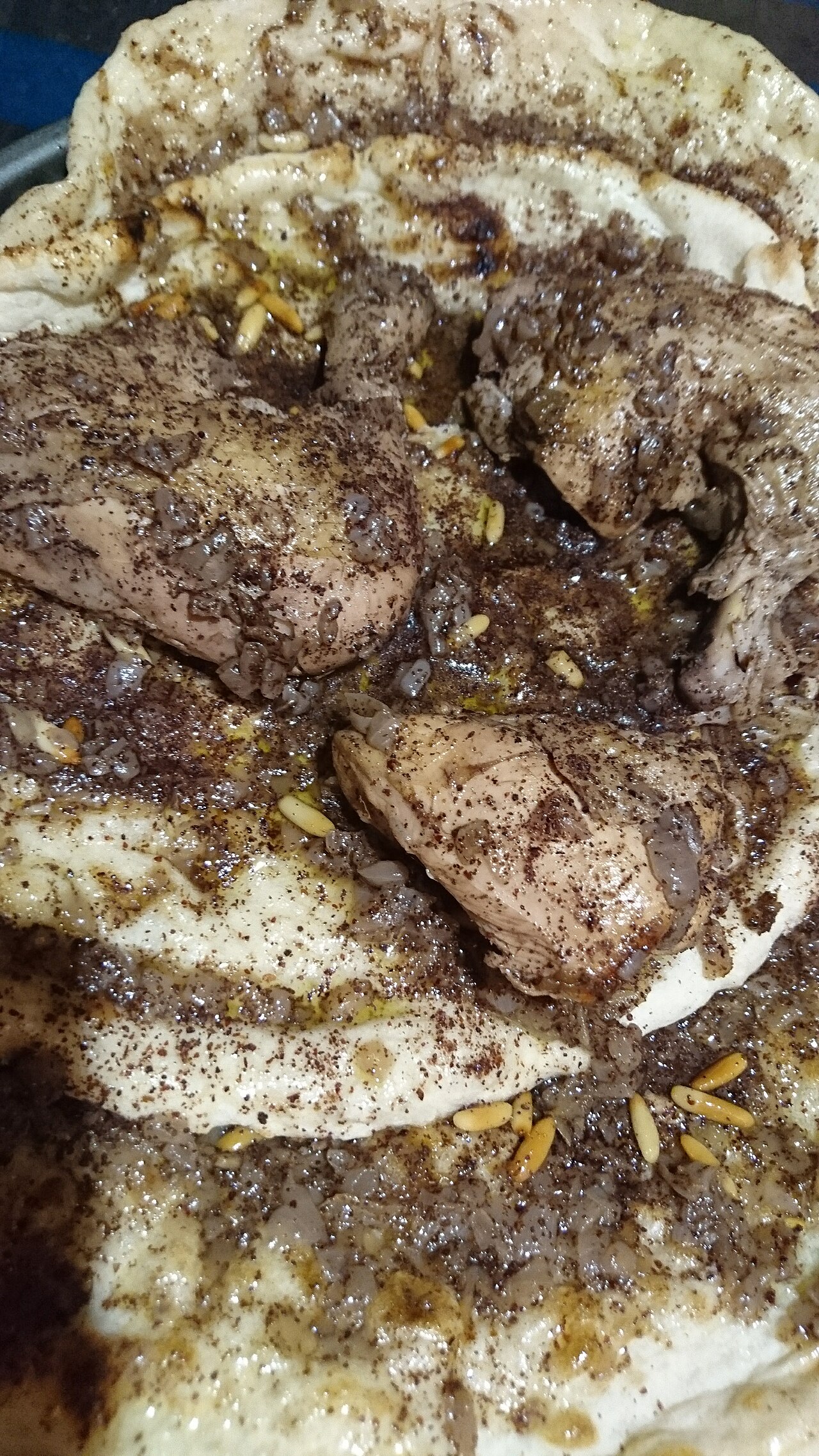
Musakhan (Arabic: مسخّن, meaning "something that is reheated"), also called muhammar (Arabic: محمّر, meaning "reddened"), is a Palestinian dish made from roasted chicken baked with onions, sumac, allspice, saffron, and fried pine nuts, all served on taboon bread. It comes from the Tulkarm and Jenin region and is widely regarded as Palestine's national dish. The meal is especially favored by Palestinians and Jordanians, and is also consumed by Druze communities in the Galilee—particularly around Iksal and Sandala—as well as in the Triangle. It can also be found in Syria, Lebanon, and Jordan. The name comes from the practice of Palestinian farmers reheating leftover taboon bread to improve its flavor. Musakhan is traditionally prepared during the olive harvest season.
The dish's exact origins are uncertain, though references appear in 19th-century Palestinian folk songs. Some accounts suggest it was created by accident: in communal ovens dug into the ground, ingredients like chicken and bread were often placed next to each other to cook at the same time, eventually ending up stacked on top of one another. Different versions of the dish have existed for about 150 years.
Preparation is straightforward, and the ingredients—olive oil, sumac, and pine nuts—are common in Palestinian cooking, which may explain the dish's widespread appeal. It is typically eaten by hand, presented with the chicken on top of the bread, and may be served with soup. Some modern versions shape the dish into rolls using thin saj bread instead of thicker taboon bread, while others turn it into a fatteh.
On April 20, 2010, the largest musakhan dish ever was made in Ramallah and entered the Guinness Book of World Records. Palestinian Prime Minister Salam Fayad called it a great achievement and honor for the Palestinian people, noting it relied entirely on Palestinian products, especially olive oil, and carried a cultural message about their legitimate rights. The loaf measured 4 meters in diameter and weighed 1,350 kg, requiring 250 kg of flour, 170 kg of olive oil, 500 kg of onions, and 70 kg of almonds from forty Palestinian cooks.
- type
- Dish
- origin
- Tulkarm and Jenin area, Palestine
- main_ingredients
- Chicken, onions, sumac, allspice, saffron, fried pine nuts, taboon bread
- also_known_as
- Muhammar
- national_dish_of
- Palestine
- popular_among
- Palestinians, Jordanians, Druze in Galilee
Lore & Background
The exact origin of the dish is unclear; references to it are found in Palestinian folk songs from the 19th-century. Some sources state that the dish was created by mistake, where in communal ovens that were dug into the ground, ingredients like chicken and bread were frequently placed next to one another to cook simultaneously, and eventually came to be placed on top of one another. Different versions of the dish have existed for 150 years.
The dish owes its name to the practice of Palestinian farmers reheating old taboon bread and make it taste better. Musakhan is traditionally cooked during the olive harvest season. Many of the ingredients used—olive oil, sumac and pine nuts—are staples of Palestinian cuisine. The dish is typically eaten with one's hands, presented with the chicken on top of the bread, and could be served with soup.
Some contemporary versions shape the dish into rolls rather than the traditional layered setup, with thin saj bread instead of the much thicker taboon bread; other contemporary versions make it into a fatteh. On April 20, 2010, the largest ever dish of musakhan was prepared in Ramallah and entered into the Guinness Book of World Records, with a total diameter of 4 meters and a total weight of 1,350 kg.
Reader's Guide
Musakhan holds significance as a cultural and culinary symbol of Palestine, often considered the national dish. Its popularity spans Palestinians, Jordanians, and Druze communities in the Galilee, and it is also found in Syria, Lebanon, and Jordan. The dish's simplicity and use of easily obtainable ingredients—olive oil, sumac, and pine nuts—reflect staples of Palestinian cuisine and may account for its widespread appeal. The name itself derives from the practice of Palestinian farmers reheating old taboon bread, linking the dish to agricultural life and resourcefulness. Traditionally cooked during the olive harvest season, musakhan embodies seasonal and communal cooking traditions. Its legacy includes a world record set in Ramallah in 2010, when the largest musakhan was prepared, highlighting Palestinian products, especially olive oil, and conveying a cultural message. The dish's unclear origin, with references in 19th-century folk songs and a possible accidental creation in communal ovens, adds to its folkloric depth. Contemporary variations, such as rolls or fatteh, show its adaptability while preserving its core identity.
Did You Know?
- The name 'musakhan' comes from the practice of Palestinian farmers reheating old taboon bread to make it taste better.
- The largest ever dish of musakhan was prepared in Ramallah on April 20, 2010, weighing 1,350 kg and measuring 4 meters in diameter.
- Some sources state the dish was created by mistake when chicken and bread were placed next to each other in communal ovens and eventually stacked.
- Different versions of musakhan have existed for 150 years.
Origins & Cultural Identity
Musakhan carries a name that literally translates to "something that is reheated," a nod to the everyday practice of Palestinian farmers salvaging stale taboon bread and giving it new life. An alternative name, muhammar, evokes the deep reddish hue the dish takes on from its sumac and spice blend. Though the precise moment of its invention remains shrouded in uncertainty, 19th-century Palestinian folk songs already sing of the dish, and various iterations have been prepared for roughly 150 years. One popular account holds that musakhan was born of happy accident: in communal ovens dug into the earth, cooks would lay chicken and bread side by side, and over time the two ended up stacked, producing the layered combination we recognize today. Rooted in the Tulkarm and Jenin region, the dish is widely regarded as Palestine's national culinary emblem. Its traditional preparation is tied to the olive harvest season, anchoring it firmly in the agricultural rhythms of the land.
Preparation & Ingredients
The beauty of musakhan lies in its accessibility. The core ingredients—roasted chicken, onions, sumac, allspice, saffron, and fried pine nuts—are staples already found in most Palestinian kitchens, and the olive oil that binds them is a cornerstone of the regional pantry. This simplicity is often cited as a reason the dish has endured and spread so widely. Traditionally, the spiced onion and chicken mixture is spread over a thick slab of taboon bread, with the chicken resting on top, and the whole is eaten by hand, sometimes accompanied by a bowl of soup. In more recent years, cooks have experimented with the format: some shape the filling into rolls using thinner saj bread, while others adapt the flavors into a fatteh-style presentation. Despite these modern variations, the essential flavor profile remains unchanged, and the dish's connection to the olive harvest season keeps it rooted in a specific time of year for many families.
Geographic Spread & Community
While musakhan is most closely identified with Palestinian identity, its reach extends well beyond a single community. Jordanians embrace the dish as their own, and it is a familiar presence across Syria and Lebanon. Among the Druze population in northern Israel, particularly in the Galilee towns of Iksal and Sandala as well as in the Triangle region, musakhan holds a special place on the table. This broad adoption across ethnic and national lines suggests that the dish transcends any single cultural boundary, functioning instead as a shared culinary heritage of the wider Levantine world. The communal oven tradition from which the dish may have originated also hints at a history of shared cooking spaces, where different groups prepared food side by side. Whether eaten during the olive harvest or at a family gathering, musakhan serves as a point of connection among Palestinians, Jordanians, Druze, and others who call the region home, reinforcing bonds of taste and memory that cross political lines.
The World Record & National Symbol
On April 20, 2010, the city of Ramallah became the stage for a culinary event of extraordinary scale. Forty Palestinian cooks collaborated to prepare a single musakhan loaf measuring four meters in diameter and weighing a staggering 1,350 kilograms. The recipe called for 250 kilograms of flour, 170 kilograms of olive oil, 500 kilograms of onions, and 70 kilograms of almonds. The dish was entered into the Guinness Book of World Records as the largest musakhan ever made. Palestinian Prime Minister Salam Fayad seized the moment to frame the achievement in political terms, calling it a great honor for the Palestinian people. He emphasized that the feat relied entirely on Palestinian products, particularly olive oil, and that it carried a cultural dimension and a message to the world about the people's legitimate rights. In that single, record-breaking loaf, the humble dish of reheated bread and spiced chicken became a powerful symbol of national pride and collective identity.
Gallery


Frequently Asked Questions
Who is Musakhan?
Musakhan is a Palestinian roasted-chicken dish whose Arabic name translates to "something that is reheated," and it is also called muhammar, meaning "reddened." It is widely regarded as the national dish of Palestine.
What are Musakhan's powers/role?
Musakhan features a whole chicken baked under a tangy glaze of sumac, allspice, saffron, caramelized onions, and fried pine nuts. The finished bird is laid on top of taboon bread, which soaks up the rich, reddish sauce and becomes the star of the plate.
Where does Musakhan come from?
The dish traces its roots to the Tulkarm and Jenin area of Palestine. It has since become a staple across the Levant, with strong followings among Palestinians, Jordanians, and Druze communities around Iksal and Sandala in the Galilee as well as in the Triangle.
How does Musakhan's story end?
The meal is traditionally pulled apart by hand at a shared table, with diners tearing sumac-soaked bread and shredding the tender, spiced chicken. It is especially favored for celebrations, family gatherings, and festive occasions across the region.
Why is Musakhan important?
As Palestine's national dish, Musakhan carries a strong sense of cultural identity and pride for its people. Its popularity in Jordan, Syria, Lebanon, and among Druze communities in the Galilee and the Triangle makes it a shared culinary heritage that binds multiple communities together.
More in Palestinian inventions 1-24
Spotted an error? Know more?
This is a living reference — every entry is fact-audited, and reader corrections feed straight into our audit queue. Suggest an edit · See this site's audit record